Cyclops Trump Amor Fati

trumpcyclopswide

The last section of the last Chapter 13 Towards an ethical epistemology in Robert Romanyshy’s compelling book Wounded Researcher: Research with soul in mind (WR) is titled Amor Fati and is a one-page ending encapsulating his 386-page opus magnum.  I can see my dream amplification in the last Blog post A Dream, Association, Amplification as my attempt to understand the unfolding processes in Robert’s book – realizing the need to understand it as amor fati? I ended this previous blog writing this:

I have been at a blackboard all my life and recently was working with Kurt Kodel’s equations in the Blog post-Trump: A space-time traveler. Karl Marx’s mathematical transformation problem has been an interest since graduate school. And this dream’s blackboard reminds me of teaching at the University Of International Business and Economics (UIBE) (1988-1991) through the Trainmen Square Massacre and its aftermath. I can remember wondering why the PRC would allow me to teach participation management principles (democracy) in a Communist State. The dynamics of this question are still with me as I study the forces in globalization. The logic like the end of history and the last man standing is on the blackboard but it has an unclear final mathematical element that my colleague Leo offers to re-state as I and several team members attentively listen. From my dissertation on this dream amplification, Romanyshyn makes this important observation, “Facing the work, one accepts that one has been called into the work through one’s complexes for the sake of becoming the agent of the work itself, accepting its imperfections and incompleteness, and, resting in that place one knows that to the best of his or her abilities, one has been faithful to the dialogue with others for whom the work has been done” (344).

The real challenge at the center of being a wounded researcher and being “called into the work through one’s complexes” is to understand one’s personal complex involved in the research project. In trying to get this completed and sent, I turned to another WR chapter, started to re-read it, and then realized that it seemed I was experiencing the holographic nature of Romanyshyn’s book. A project exploring this concept is going to take more space-time – a wounded researcher’s question, “Is the Soul holographic, and what would be its mathematics?” I then posted Michael Talbot’s interview on the Holographic Universe and the mathematics of the Fourier Transformation, of all things, presented on a blackboard.

I realized I needed to expand Romanyshyn’s one-page section, Amor Fait. What is the deep of this concept?  I started with this Wikipedia entry: “Amor Fati is a Latin phrase that may be translated as ‘love of fate’ or ‘love of one’s fate. It is used to describe an attitude in which one sees everything that happens in one’s life, including suffering and loss, as good or, at the very least,  necessary, in that they are among the facts of one’s life and existence, so they are always necessarily there whether one likes them or not. Moreover, amor fati is characterized by an acceptance of the events or situations that occur in one’s life. This acceptance does not necessarily preclude an attempt at change or improvement, but rather, it can be seen to be along the lines of what Friedrich Nietzsche means by the concept of eternal recurrence: a sense of contentment with one’s life and an acceptance of it, such that one could live exactly the same life, in all its minute details, over and over for all eternity.

This got me started but it quickly took me down rabbit holes reading other materials. The amor fati concept is used repeatedly in Nietzsche’s writings and is representative of the general outlook on life that he articulates in section 276 of The Gay Science: “I want to learn more and more to see as beautiful what is necessary in things; then I shall be one of those who make things beautiful. Amor fati: let that be my love henceforth! I do not want to wage war against what is ugly. I do not want to accuse; I do not even want to accuse those who accuse. Looking away shall be my only negation. And all in all and on the whole: someday I wish to be only a Yes-sayer.”  It is important to note that Nietzsche in this context refers to the “Yes-sayer”, not in a political or social sense, but as a person who is capable of uncompromising acceptance of reality per se. Quotation from “Why I Am So Clever” in Ecce Homo, section 10.

I quickly realized that I needed to augment my learning strategy of reading Nietzsche passages from Wikipedia to seeing if Youtube would get me through the challenging task of understanding the core of Nietzsche’s thought. I was pleasantly surprised in finding several Youtube lectures providing insights into Nietzsche and Romanyshyn’s use of Amor fati as a principle underpinning both approaches to life. These unfolded in this order and each adds a different view to my question: How do Nietzsche’s and Romanyshny’s projects overlap and how are they contributing to my project?  I worked through several Youtube clips Nietzsche in 12 minutes, in 50 minutes, in 90 minutes, all interesting presentations. Nietzsche In Twelve Minutes  give a quick overview of his thought.

However, what seemed to offer a deep dive into amor fait was the clip 45 minutes on a single paragraph of Nietzsche’s Beyond Good & Evil.  I was intrigued by Professor Jordan Peterson’s discussion of a single paragraph from Nietzsche’s Beyond Good and Evil. I have tracked it with time marks quoting, and paraphrasing Peterson’s presentation. I began to see how Romanyshyn and Nietzsche’s projects were similar – they both were writing with soul in mind and their “ability to layer meaning upon meaning in a few sentences requires an extreme intensity of thought” (Peterson). I will transcribe and comment 0n Jordan’s lecture and on some of Romanyshyn’s similarities. I will continue blogging about this as as my project unfolds.

I started this blog on 11.03.2016 and am finishing it on 11.11.2016 after being in shock for 24 hours after Trump was elected President. I was told by a friend to take a breath – it took 11,520 breaths, after Trump was elected for me to begin my recovering process. The ending of Peterson’s analysis, I recently re-listening to, startled me – it recalls the warning presented in the Blog Post Trickster Donald Trump that Trump may now be a Cyclopes – an omen to be on guard to. The 45 minutes ends at 39:50 suggesting that the “One-eyed monster, the Cyclopes want to be the dominate one. He organizes a structure and appears at the top of the pyramid in control. I am now becoming aware that this is being written not only about me but all of us, also about Donald Trump now at the top of our collective pyramid USA. What is he up to? The processes Peterson presents for you and I is one thing but to see that Trump as the US President is probably just now stumbling into this challenge, is concerning to say the least. We simple do not know what he is up to.

Jordan B Peterson 45 minutes on a single paragraph of Nietzsche’s Beyond Good and Evil Beyond Good & Evil Section 1 Prejudice of Philosophers

1:00 All great authors collect unconscious patterns from his or her interactions in the world, giving them an initial formulation, and the patterns can be deep, multilevel, and the initial formulations are translated into ideas not so many ideas but into the seeds of future ideas. And the more poetic the author happens to be, the more his or her writings contain these seeds of future ideas. This is the quality of thought of the “romantics”. This paragraph illustrates Nietzsche’s process of thinking.

4:00 Why does it matter to bother with this book at all. Nietzsche is interested in the issue of “values”. The problem of value is not what the world is made of, or even how the world functions, which are more scientific questions, it is how you should conduct yourself in the world, how should you act. And people act toward aims in a sense because we are moving from one point to another, we are moving toward things that we want, toward our desires. We are guided by our values but by the structure of how those values are related to one another.

4:45 So, for example, if you have a roomful of people, a roomful of children. A congress is full of elected representatives. They are active children and at some point, they may choose to play a game or organize together to accomplish an aim and this is a micro-society with rules of the game. We do this socially because we have to get along with others and we also do this psychologically and together this is sort of a dance. As I am interacting with other people, the demands of the group are such that one organizes his own demands such that they take into consideration the others’ structure. We are constantly observing these social processes and using this in organizing our own psychological structure in order to get along and together accomplish our goals. This is a dynamic inter-actional dance processing by which the society in self-organizing and used by the individual psyche self-organizing to fit in. This is the processes that Nietzsche is presenting in this paragraph.

6:00 What’s the utility of this dance? We as individuals have to arrange our desires and values so they are acceptable to everyone else. If we do not want to run afoul of our own desires and values, one has to organize them. Some are short, medium, or long term and we do not want them getting in the way of each other. Example of lover and wife given – tell me we have not been here. The purpose of thinking this through it to be able to move forward in a world without getting killed or killing. So, reading philosophy like Nietzsche’s is that it can help us think these things through and avoid wars – individual and collective. Nietzsche is one in a billion thinkers so, why not get him on Trump’s team.

10:00 “It has gradually become clear to me, what every great philosophy up to now has consisted of, namely the confession of its originator and species of involuntary and unconscious autobiography.” Here the difference between being a “rational being” and a “living being” is differentiated.  Nietzsche says that “truth serves life” which is different than saying “truth is an accurate representation of the world”. Here Nietzsche’s meta-physics philosophy idea is outlined. One is working at attempting to arrange one’s systems of values that make sense and will assist one in plotting the journey through life. In doing this one is writing one’s autobiography, one is like writing a story, one is writing with soul in mind, and one is a Romanyshyn wounded researcher in motion.

16:55 “A species of involuntary and unconscious autobiography…” we as a species value one another because we engage and share with one another our biographical selves – “you tell me your story and I tell you my story” and this is important because our stories help each of us address the trials of life we encounter. If we can learn, here we can say deeply empathize with each other, we as a civilization will advance more effectively and efficiently. Nietzsche’s point is that this activity is involuntary and unconscious in humans and his philosophy is to make this important human activity conscious, it is the primary task of the Wounded Researcher – understanding the complexes in a research project – in a new administration. “People have a built in value not to question what one is engaged in.” The introduction of the idea that you should analyze whatever you are engaged in when you are reading, comes as un-welcomed news to a new student having to detach him/herself and think about what one is doing.” “It is one of the things within which thought operates, rather than one of the things on which thought operates.”

19:55 The ultimate question in life is to what is one’s life aimed? We as a species are 3.5 billion years old. What is inside you – it is all of these years rolled into you. God only knows. Who cares, you care – everything is a manifestation of your ethic. CG Jung was a student of Nietzsche and surrounds his study about the individual story. All of this is inside us and our task is to understand this. Everything good or evil in the world is a consequence of your value system. This determines how one moves through life. We become more aware of this as we move closer to death. Now his is hitting close to me at 72.

24:00 The moral or immoral purpose in every philosophy has constituted the true vital germ out of which the total plant is always grown. One cannot help reveal this plant. How Hitler died story – alters us to what some are not saying is unfolding for Trump.

26:00 What morally is a person up to? What is the person up to? What does it mean that a person is aiming at something? I do not believe that an impulse to knowledge is the father of philosophy but that another impulse has made use of knowledge and mistaken knowledge as an instrument. Nietzsche questions the impulse to a knowledge issue. Here the deconstructionist issue is analyzed – that what the philosopher is really up to in writing is the impulse to power. Whatever you are telling me to dominate me regardless of what it is you claim to be doing. The problem is that it implies the only value people have is to dominate. This could be the case and in some, it likely is the case. But one should not make this the highest aim in life. (Aziz’s work) The idea of the will to power has to be further examined. What does Nietzsche mean by the will to power?

31:00 Marx and materialism are addressed here and this needs to be further addressed. (Holt’s work)

32:00 People working for the system, like government agencies and universities:  in the case of these men, scholars, there may be a quest for knowledge. Like a clock when wound up works industrially to the end. (Dangerous Knowledge Theme) This issue may be a will to knowledge but we can not say that it is the top value. There is another web of values lurking in the background. This is deeper than first thought.

35:00 What is a book look like. Nietzsche’s book Good and evil is a bomb, every sentence explodes with deeper meaning.

36:00 There are fundamental impulses in human beings. People do have impulses. How do they play themselves out in our life? There is a place where these impulses live. They do live. This was so cool, as Peterson is describing these many impulses, demons, taking one over, I saw them operating in life just then. His description was just then working its magic on me!

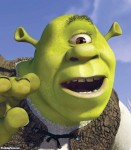
39:50 One-eyed monster, a Cyclops wants to be the dominant one – only I can solve our problems Trump has said. The Cyclops organizes the structure and appears at its top to control it – today 11/10/2016 begins Trump’s transition to the Presidency of the United States, as worries of fascism abound. I was hoping we did not have to witness this unfold with someone at the top of Western Civilization’s leading nation but this is now our fate! This of course is now the challenge to every one of us – deep thinking about values. We now have the ultimate reality show and we all are players. This Nietzsche paragraph is our World’s collective challenge. I feel I am slipping back into shock. Help! Where are you Shrek?

cyclops-2


I will end this Blog entry with this broad overview on  Nietzsche and ‘Amor Fati’.

Oh Shrek, there you are! Where is your other eye? How do we get us out of here?
We know Trump lies, does he also wears women’s underwear? Hallelujah!
shrek-cyclops-34636

Steven.Scherling@gmail.com

Posted in Uncategorized | 6 Comments

A Dream, Association, Amplification

dream-110/28/2016 Dream: I am in a 50’s classroom with wooden desks and black-broads on all the walls. I was at the front black-board examining the work written there and noticed at the lower right corner a part of the final mathematical equation has been erased and asked the team with me in the room about this. One fellow, a little older, said here it is and was at the side black-board on the right writing out the equation as I and the other two team members watched and listened to what was being written and explained.

Association: I am first reminded of teaching in this class room at UIBE in Beijing and filling the front blackboard by writing my lectures notes from the upper left to the lower right. We also began every day listening to the Voice of America news with special reports on the pending 1989 Kuwait rescue lead by the US. This also reminds me of the effort in the movie Interstellar looking for mathematical equation to help solve the global environmental disaster facing Earth. I also thought of the movie Good Will Hunting and Will solving mathematical problems on a university hall blackboard. Also I associate my blog entry Trump: A Space-Time Traveler where I entertained Kurt Gödel’s incompleteness theorems. And finally most recently, I associate the my Dream 10.26.2016 where I projected a complex issue onto my friend and former colleague Leo. I was in the midst of working this through when I had this dream, whose amplification continues the processes of understanding what is unfolding.

https://www.youtube.com/watch?v=n1wgEVOeiQQ&list=PLDCA39BA6CD14422A

Amplification: Here is what I wrote as part of my amplification to the 10.26 dream: When I first started teaching at UND in 1974, the pedagogy I began using was the experiential learning model and at the undergraduate level I had to generate class-room experiences to analyze. In MBA courses with practicing managers, they used their working experiences to analyze, relate to theory, and weekly write a 5-page paper. What I recently realized is that my blogging experiences on Trump are in essence a continuation of this classroom experiential pedagogy? The theory I am using is presented in Robert Romanyshyn’s book The Wounded Researcher: Research with soul in mind (WR). In the last Blog post I was applying WR Chapter 12 on Writing down the soul. Then other day I re-read Chapter 13 Towards an ethical epistemology, which I will make use of in this blog entry following on the Trump: A New Moses post. Chapter 13 is the theory helping analyze a recent experience I had with a former UND colleague that is causing me to re-think the new ethics.

I now move to amplifying this latest dream. I have been re-reading Romanyshyn chapters and during the night decided to re-study Chapter 13 towards an ethical epistemology and drill down into what this chapter proposes. I am drilling into the difference between the ending in the Trump as Moses blog post listing my previous blogs presenting the new ethic, A New Depth Ethic, Deep Jesus, Us?, The Mathematics of Faith?, and what Romanyshyn proposes in his Chapter 13. Is there something new in his ethical epistemology chapter that extends the new ethics outlined?

We begin by presenting Wikipedia’s definition of epistemology as “the nature of knowledge, the rationality of belief, and justification. Much of the debate in epistemology centers on four areas: (1) the philosophical analysis of the nature of knowledge and how it relates to such concepts as truth, belief, and justification, (2) various problems of skepticism, (3) the sources and scope of knowledge and justified belief, and (4) the criteria for knowledge and justification.” I do not intend to address these points but want to keep this definition in mind as a reference to what will eventually unfold. Romanyshyn begins Chapter 13 with an interesting quote from Erich Neumann’s cornerstone book Depth psychology and a new ethic, …[T]he old ethic … an ethic of conscious attitude … is typified by the text form St. Augustine (354-430) in which the saint thanks God that he is  not responsible to him for his dreams.” Today, 2000 years on, things have changed – we are responsible for our dreams, however, not many realize this!

We begin by saying that Romanyshyn’s WR project, as a whole is itself moving towards an ethical epistemology and is seen addressing the full definition of epistemology. This said, what Romanyshyn attempts in his last Chapter 13 to understand his experience of writing this last chapter by applying his project’s epistemology – the ethical responsibility all researchers have in understanding how their personal complex influences conducting of their research projects. Romanyshyn’s project has been birthing this book for 20 years and this morning he is describing at the beginning of this chapter his sixth time starting to write the chapter and his anxious feeling from the pressure of deadlines to complete the book. Contributing to his anxiety is that this morning he did not follow his usual “routine of dedicating the day to his ancestors” and to others gathered around his writing table (333).

Romanyshyn begins this chapter telling a dream he had the night before that was related to his anxiety feelings about time deadlines coming from his publisher. In Robert’s dream he was in a classroom group taking a timed paper-pencil test. He realizes 20 minutes into hour test that he has the wrong test, pencil, and he approaches the proctor who is busy talking with another person on frivolous things and does not pay attention to him – he is anxious not having the right tools to complete the test. Robert is sure he has to take notice of this dream as it relates to his writing this last chapter as he quotes Jung asserting, “The images of the unconscious place a great responsibility upon a man” and “[i]nsight into them must be converted into an ethical obligation” (Jung, MDR, 1965:193).

After an initial amplification of this dream, Robert moves to his morning ritual, a nod to his ancestors, continued writing the ethics chapter, and keeping the dream image present as its amplification matures. Robert ends this prelude to this chapter, saying “I am making a place for the dream in the work, which is what an alchemical hermeneutic method does,…the dream is not the content of the research or this chapter … The dream in research is a way of doing research, a path that can be followed, part of a method that would keep soul in mind,:” and as he worked this day he amplified the dream throughout the day as it revealed meaning to what was unfolding in writing this last chapter. Robert’s dream informed him about what was coming down as he began writing this last important chapter. I am now mindful of what my dream is revealing about my project?

Romanyshyn is now ready to introduce Chapter 13 and he does so with another quotation from Neumann (p.74): … [T]he old ethic is a partial ethic … it fails to take into consideration or to evaluate the tendencies and effects of the unconscious … Within the life of the community, this takes the shape of the psychology of the scapegoat; in international relations it appears in the form of those epidemic outbreaks of atavistic mass reaction known as war.

If our epistemology does not take into consideration the unconscious, our dreams, they are “one-sided, fixed truths and ideological exercises of power (emphasis added). Romanyshyn points to the example of the historical development of depth psychology to see “how differences with the other without proper consideration of the other in oneself, lead to animosity toward and the demonizing of the other.”  Looking at republican and democrat animosities, I think it is accurate to conclude that these individuals’ do not understand what the new ethic requires, working with one’s shadow and the other. I then had to ask myself, Steven, if you claim to understand and are trying to live this new ethic, how can you explain the animosity recently shown towards a friend and past colleague, Leo? This is the mystery under investigation and the plot deepens in Robert’s next observation that I think is on the trail of explaining this quandary.

Romanyshyn asks us to consider this issue: … “how can the ethos of Western science, despite its great achievements, cast a huge shadow of destruction over human life and the environment” – capitalism has produced great wealth, high living standards, in the midst of inequalities, starvation, unemployment, weapons of mass-destruction, constant wars, and global warming!  If a friend, a colleague, holds the opposite logic on global warming as you, how can they accept each other living under the same teepee? Robert suggests that “All the bodies of knowledge we create, like those who create them cast a shadow. The challenge is coming to terms with “the shadow side of our ways of knowing and constructing the world. An ethical epistemology would have us make a place for the unconscious in our ways of knowing the world” (336). This is the essential difference between Leo and I, which and Zizek’s clip on the pervert’s guide to ideology addresses. I sent this to Leo believing he needed to be forced to put on the ideological classes allowing him to see into the ideology, the shadow of capitalism. I anticipated it was going to verbally violent since we live 1500 miles apart and besides he is much bigger than I.

What I attempt in the publication and Blog post Kapitalism On The Couch, is a psychoanalytical approach to analyze capitalism’s shadow. This project stirred some anxieties in the application of The Wounded Researcher’s ethics epistemology to global corporate capitalism. I wouldn’t have mind if my friend Leo had built his case like Francis Fukuyama’s “the end of history and the last man” , reaching the conclusion that liberal democratic capitalism is the Promised Land. Fukuyama soon had to discard his argument, however, Leo, lacking a logic just trashed the idea that capitalism might have a dark other  side. So, here is my dilemma, how can I respect the other when the other does not respect himself with a well-thought-out-logic that respects our common mother – Mother Earth? This is a disrespect that will eventually kill us and our childrens children’s children.

Romanyshyn ends this introduction challenging my understanding of my inner personal shadow other and the outer other. “The present day shows,” he writes, “with appalling clarity how little able people are to let the other man’s argument count, although this capacity is a fundamental and indispensable condition for any human community. Everyone who proposes to come to terms with himself must reckon with this basic problem. For, to the degree that he does not admit the validity of the other person, he denies the ‘other’ within the right to exist – and vice versa. The capacity for inner dialogue is the touchstone for outer objectivity” (Jung, TTF, p187).

This is the challenge not only facing Leo and I but also the World rite large – republicans and democrats. It currently does not seem possible for Western Civilization to accept a big Other, ISIS – both are now left to killing one another – can there ever be an authentic dialogue? Also as we wind down this bitter 2016 US election, the mutually assured destruction buttons have been pressed. And inside our teepee, Leo and I need a peace-pipe, but what is smoked has to properly alter our consciousness. For Romanyshyn’s epistemology to remain viable both parties have to gain from a dialogue, and that means being able to see some newness in the other’s logic that can be added to one’s own understanding – raising all levels of consciousness. It seems that if the other does not come to dialogue table ready to speak/debate/write consistently, logically, heart-felt then there is no incentive to engage in dialogue. Seeing our own evil is challenging!

This is my amplification half way through Romanyshyn’s Chapter 13, which I was again re-reading in the night anxious to get this amplification finished correctly. I was fearful that I might be mistaken, but I sensed from previous readings there is a hidden jewel of understanding to be mined here. Heaven forbid could I ever be mistaken? Yaa! Then in the night 10.29 I had fallen asleep asking about my way through this dream amplification and had this dream: I heard a voice say “metaphoric sensibility” and I said “yes, that’s it, thank you”. I recorded the dream and fell back to sleep.

Getting up, brewing coffee, welcoming ancestors to gather around, I began working with the third section of Chapter 13 A few reflections. In terms of Kolb’s experiential learning model, reflections work with our experiences and our theories especially the ones we are currently studying. Then begins in earnest the 4th and final element of our experiential learning modelexperimentation in writing with soul in mind – I felt loaded for bear.

Romanyshyn presents metaphoric sensibility in Chapter 12 Writing down the soul (314-327) and says that “adopting this sensibility towards one’s work allows the researcher to remain open, curious, and inclined toward the “not yet” of the work that is held as a possibility in the ‘is not’ of metaphor. The ‘is not’ of metaphor is always a mystery and the mystery of metaphor invites the wounded researcher to keep the mystery in the work alive, primarily by avoiding any premature closure of meaning, by allowing the work to dissolve itself when it has become too fixed.”  Here is the struggle I was having at this point reflecting on this dream, it is “the tension between ‘is’ and ‘is not’ of metaphor, is the tension between the ego’s intentions for the work and the soul of the work.” What I am now in the midst of moving toward is “In the ‘is not’ of one’s metaphorical writing is the path to writing down the soul of the work” (323).

Romanyshyn elaborates further on metaphoric sensibility as it applies to an ethical way of knowing by suggesting there are two moments necessary to understand and practice. The first moment is that “to appreciate oneself as an other, it is necessary to be in dialogue with an other.” The outcome of this moment is the other reflects back to you that your view is one respective among equals. “The other sees things differently,” Romanyshyn writes, “from another perspective, and with this recognition the other challenges who one is and how one imagines the world.” A key aspect in this process, that I am adding here,  is that the challenge to one’s perspective has to be seen as creditable to the point that one becomes curious in seeing in the dialogue the potential of broadening one’s own level of understanding – one’s level of consciousness. When I tried to open a dialogue with Leo, by sending him Zizek’s clip on “what it means to be a revolutionary,” his comment was that it was boring, illogical, Marxist propaganda and then said he quit watching soon after it began. Certainly, not a stimulus to dialogue!

Romanyshyn points out that “… if the conversation is to be truly transformative for each, if each is to see his or her view as a perspective among others, then each has to be able to listen.” A metaphoric sensibility begins by listening deeply to the other perspective and then and only then speaking. Leo’s comment was a “kick-in-the-balls,” to paraphrase a Zizek joke that he missed not listening to the end of the meaning of a revolutionary clip – this killed my desire to attempt another  dialogue – there was no way I could see a dialogue with Leo broadening my view of the World. What I saw were holes in his logic, which I did comment on, not in my best way, my fault addressed in the second moment. However, by this time I think we both felt it was not worth the effort, as this second moment seems to have been lost. I am not sure, if forever.

The second moment in metaphoric sensibility is the capacity to listen, which I see as the jewel hiding in the rough and tumble of the dialogue, and it is a key to understand both the inner and the outer others! This listening capacity is a disposition to pause when hearing the other’s words, letting them settle into the heart before the head takes over. Romanyshyn asserts this “requires a change of heart, and this change of heart involves an emotional aspect in one’s confrontation with the other.” And now we are approaching the hidden jewel in that “a different perspective challenges one’s certitude by transforming it into a perspective and presenting an emotional challenge.” Romanyshyn then uncovers the jewel being sought, “… the other’s perspective speaks to the other within oneself, and when that other within is unconscious, when it lives in one’s life as a shadow, this emotional challenge is more often than not more than one wishes to hear” (340). When I read this, I stepped back from my periscope and realized that I was as much at fault in ending our dialogue as I thought Leo was. It was a different aspect of the dialogue dynamics being examined. This gave me a different window into seeing my shadow and what I am realizing is that I have “shadow work” to do and have a new perspective in doing it – Leo’s perspective I need to more carefully examine, however, I still hope my friend will develop a logical argument.

The next section of Chapter 13 is Re-Search as an ethical responsibility that addresses the issue of ethics in conducting research projects. Several years ago another colleague told me about his published research paper on ethics and that his team’s effort to have a high powered quant-guy on board to crank the numbers. I asked if they had an equally high-powered analytical psychologist on the team – they had not. Romanyshyn’s makes two points on this ethics research project that I will briefly comment on. A researcher’s psychological complex, which is projected into the research project has to be taken into consideration, just as in quantum physics research. The second point is most interesting and let me quote Robert: “The researcher is also ethically obligated to make a place for the strangers in the work; those others who carry the unfinished business in the soul of the work. The ancestors for whom the work is done, that great extended family who line the corridors of history, as Jung speaks of them, gathered around the writing-table, their questions waiting to be heard. We owe them our attention if we are to keep the soul of the work in mind. We have an ethical responsibility to lend them an ear. For re-search with soul in mind, the ethical responsibility we have toward our subjects extends to the ethical responsibility we have toward the work” (342).

The anxiety Robert reveals at the beginning of this chapter emanated in part from his forgetting to greet his ancestors and interested friends also up early, gathered around his writing-table, ready to participate in the day’s work. I just let out a hardy laugh, a smile, and now tears are coming to my eyes. I had greeted my ancestors this morning with a bow to remembering them, seeing their photographs on my walls and their books in my bookcases. And just now, I am thinking of my grandfather Arvid Rudolf Scherling, my namesake, as he is here beside me now looking over my shoulder at what I wrote in my notebook last night – the title of his book “The dogma of a sinful constitution by ARS” and underneath I wrote “The dogma of a capitalist constitution by SAS.” I see him now smiling, saying “go for it Steven Arvid!”

The last section is Amor Fati, which Wikipedia defines as “a Latin phrase that may be translated as ‘love of fate’ or ‘love of one’s fate’”. I think this dream amplified is a direct experience of amor fait.  I have been at a blackboard all my life and recently was working with Kurt Kodel’s equations in the Blog post titled Trump: A space-time traveler. Karl Marx’s mathematical transformation problem has been an interest since graduate school. And this dream’s blackboard reminds me of teaching at the University of International Business and Economics (UIBE) (1988-1991) right through The Trainmen Square Massacre and its aftermath. I can remember wondering why the PRC would allow me to teach participation management principles (democracy) in a Communist State? The dynamics of this question are still with me as I study the forces in globalization. The logic like the end of history and the last man standing is on the blackboard but it has an unclear final mathematical element that a colleague (Leo) offers to re-state as I and several team members attentively listen to. From my dissertation to this dream amplification, Romanyshyn makes this important observation, “Facing the work, one accepts that one has been called into the work through one’s complexes for the sake of becoming the agent of the work itself, accepting its imperfections and incompleteness, and, resting in that place one knows that to the best of his or her abilities, one has been faithful to the dialogue with others for whom the work has been done” (344).

The real challenge at the center of being a wounded researcher and being “called into the work though one’s complexes” is to understand one’s complex involved in the research project. In trying to get this competed and sent, I turned to another chapter, started to read, and then realized that I was experiencing the holographic nature of Romanyshyn’s book. A project exploring this concept is going to take more space-time – a wounded researcher’s question, “Is the Soul holographic and what would be its mathematics?”

Michael Talbot – Synchronicity and the Holographic Universe


Fourier Series


Fourier Transform, Fourier Series, and frequency spectrum


Series of Dreams – Bob Dylan


Posted in Uncategorized | 4 Comments

Trump: A New Moses

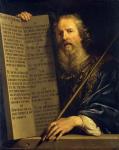
philippe_de_champaigne_-_moses_with_the_ten_commandments_-_wga04717In a previous post Trickster Donald Trump, Carl Jung’s essay On the psychology of the trickster was used to analyze Donald Trump psyche. Jung pointed out that at the end of the trickster cycle the behavior of a savior arises. Examining Trumps rhetoric it appears that he is seeing himself as Christ, “taking on the arrow of the media” to save his followers and lead them into the Promised Land of Republican controlled government. Jung cautions us that when dealing with a Trickster we must remain alert to his tricks. I think we saw one developing that was identified in the entries Atlas is Shrugging!, Trump: The Killing Trick, and Trump: A Space-Time Traveler. However, we cannot let down our guard – Donald is tricky and last week he shifted from a New Testament Savior, Christ; to the Old Testament Savior, Moses.

Last week Donald Trump went up to the top of his Trump Tower to meet with God, who gave him his Ethics Plan – A Tablet of Six Commandments, which he outlined in his Gettysburg Address to faithful followers. I listened and immediately saw that Trump’s Ethics Plan is Old Testament – it comes down to us as rules that must be followed if he is elected. After thousands of years of the Old Testament’s 10 Commandments how ethical are we – it is getting worse! It seems that Trump is unaware that there is a New Testament Ethic that puts the responsibility on the Individual to behave ethically. To understand the New Depth Ethic one has to be self-reflective, not a level of differentiation that Donald’s psyche has yet reached! However, after 116 years of trying to live this New Ethic, we are still getting worse! Does the continuum hypothesis apply to The Mathematics of Faith?, is there no way that “loving thy neighbor as thy Self” can be actualized. After all what do we expect – we do not even know how to love our Self! sas

A New Depth Ethic
Deep Jesus, Us?
The Mathematics of Faith?

Posted in Uncategorized | 4 Comments

Trump: A Space-Time Traveler

infinity-image-1I was up at 4am 10.16 after recording the dream that had me in a reception area with my daughter Annah talking to a HRM fellow about Annah’s qualification to be hired for a job. As I was supporting Annah, we soon realized that I was projecting my Anima and as I continued speaking my focus shifted becoming more detailed and dynamic on why I should be hired. The HRM person’s attention turned toward me and one amplification is that I was at Fargo’s Microsoft office applying for a job. I then wondered, at 72 what might MS hire me to do? Of course, it would be about Romanyshyn (2007) consuming book The Wounded Researcher: Research with soul in mind  and in particular right now Chapter 12 – Writing down the soul, which begins with this quote from Susan Rowland’s (2005:23) book Jung as a writer: “Anything derived merely from rationality risks being profoundly inauthentic unless it also bears witness to the destabilizing presence of the unconscious.”

Let me amplify further by saying that in writing down soul, I am being aided with Rowland’s work  Jung as a Writer, where she systematically explores Jung’s writings approach. I have studied Romanyshyn and Rowland and they both emphasize that to understand something one has to experience it – I now sense that Robert, Susan, my grandfather Arvid author of “The Dogma of a Sinful Constitution”,  my mother author of “Billiette Calling” and others are around now as I am writing this – hello everyone, pull-up a chair and let’s get further into this unfolding project. Susan Rowland Jung and writing

Last week I re-watched the movie Interstellar that I blogged about in the Tesseract entry after first seeing the movie December 2015. The movie’s director hired a UCLA astrophysicist to consult on the movie’s science and in the Tesseract library scene where pilot Coop communicates mathematical solutions for his daughter Murf’s equations that she needed to address the Earth’s ecocriticism issue is intriguing! What are the mathematical equations being transferred in this quantifiable connection scene. I think we will discover mathematician Kurt Gödel’s finger prints.

I am re-organizing three home libraries; grandfather’s, mother’s, and mine. I have several books on space-time and the other day Rudy Rucker’s book Infinity and the Mind “pushed” itself out of a bookcase and into my field of vision. I looked over the chapters and Chapter Four: Robots and Souls attracted my attention since it is related to the recent blog Atlas is Shrugging! This blog entry was after watching the “60 Minutes Show” Artificial Intelligence where I fantasized that AI efforts will soon allow us to replace politicians with Bicentennial Men and Women, a big improvement! I then watched the Presidential debate, 10.09.2016, asking when will robots replace the ongoing Donald & Hillary Comedy Show?

What then pulled me deeper into Chapter Four was Rucker’s interviews with Kurt Gödel on his Incompleteness Theorem. David Malone’s 2007 documentary Dangerous Knowledge, traces the mathematical logic of Georg Cantor, Ludwig Boltzmann, Kurt Gödel and Alan Turing setting the stage for a Schlock Holmes mystery. The idea of infinity is at the center of these mathematicians’ projects and forms the foundation of today’s work on artificial intelligence. Their mathematical reasoning resulted in Truing creating the first computer, which cracked the German Enigma machine in the movie The Imitation Game. These clips present a historical account of the evolution of mathematics and physics at the turn to the 20th Century. Malone’s film sets the scene for looking at time travel and my intuition that Donald Trump is a space-time traveler. In a follow-up blog entry, I will examine Gödel’s contribution to artificial intelligence.

Dangerous Knowledge 1 Georg Cantor and Ludwig Boltzmann

Dangerous Knowledge 2 Kurt Gödel and Alan Turing

Many thoughts flowed from this dangerous knowledge. I remember studying 2+2 = 4 at Clara Barton; 3(x) + 9 = 18 at Agassiz; ax2 + bx + c = 0 at Central High; and  aSb f(x) dx = F(b)-F(a) at UND. I did not go beyond differential equations and calculus so, when reading several of my library’s books like Infinity and the Mind, I muddle through the numbers until tiring, accepting the proofs, then turning to the philosophical views and their implications. All the great thinkers have a mathematics undergirding their theoretical paradigms and when I hit-the-wall in grasping Rucker’s mathematics, I looked at his Conversations with Gödel – he had three of them. My attempt here is to take something away from my encounter with Gödel’s Incompleteness Theorems – it will not be mathematical but I expect it to be philosophical.

Here is a concise presentation by Professor Mark Colyvan University of Sydney (2009) on Kurt Gödel and the limts of mathematics and in Part 3 Colyvan covers the issue of space-time and time travel, which Rucker talked with Gödel about and produced my intuition that Donald Trump might be a space-time traveler.

Kurt Godel: The World’s Most Incredible Mind (Part 1 of 3)

It is said that Kurt Gödel had a mind on the level of Aristotle, Pythagoras, Newton, Darwin, Einstein, Hegel… quite a bunch to visit a pub with. Gödel died by starvation and exhaustion, similar to Jimmy Hendricks dying in his own vomit and exhausted. There is something about being a mathematician and a musician that drives some insane. Rucker observes that Gödel spent “his later years in ever-deepening silence.” However, once Rucker was able to open a dialogue with Gödel, he described it “much like direct telepathic communication”. Gödel’s mind was “unbelievable fast and experienced…as if he had already thought every possible philosophical problem through to the very end” (179). Gödel’s philosopher of choice was Immanuel Kant, which is another nodal point in the matrix of Gödel’s psyche we might explore. How would changing to philosopher Fredrick Hegel impact Gödel’s thought? For now, however, we need to study the first issue Rucker discusses with Gödel, space-time travel.

Rucker addresses Gödel’s 1949 less well-known paper A remark on the Relationship between Relativity and Idealistic Philosophy. Gödel and Einstein were colleagues at Princeton’s Institute for Advanced Study and they often strolled the grounds chatting about relativity. Imagine after walking with Einstein, getting up to speed, Gödel wrote and published an extension of relativity theory! In this paper Rucker says Gödel “attempts to show that the passage of time is an illusion. The past, present and future of the universe are just different regions of a single vast space-time. Time is part of space-time, but space-time is a higher reality existing outside of time” (180).

Rucker suggests that in addressing this “time –bound notion of the universe,” Gödel constructed “a mathematical description of a possible universe in which one can travel back through time. His motivation was that if one can conceive of time-traveling to last year, then one is pretty well forced to admit the existence of something besides the immediate present” (180). Here is a visualization of the Gödel universe where time travel to past is seen as a possiblity.

Rucker is not comfortable with this idea and sites the grandfather paradox: “What if I were to travel back in time and kill my past self? If my past self died, then there would be no I to travel back in time, so I wouldn’t kill my past self after all. So then the time-trip would take place, and I would kill my past self. And so on. I was also disturbed by the fact that if the future is already there, then there is some sense in which our free will is an illusion” (180).

Rucker goes on to state that “Gödel seemed to believe that not only is the future already there, but worse, that it is, in principle, possible to predict completely the actions of some given person”, and objecting to this in “that if there were a completely accurate theory predicting my actions, then I could prove the theory false – by learning the theory and then doing the opposite of what it predicted. According to Rucker’s notes Gödel’s response was, “It should be possible to form a complete theory of human behavior, i.e., to predict from the hereditary and environmental givens what a person will do. However, if a mischievous person learns of this theory, he can act in a way so as to negate it. Hence I conclude that such a theory exists, but that no mischievous person will ever learn it. In the same way, time-travel is possible, but no person will ever mange to kill his past self’. Gödel then laughed his special awareness laugh and ended with ‘The a priori is greatly neglected. Logic is very powerful’” (181).

At another time Gödel responded to the free will issue saying, “There is no contradiction between free will and knowing in advance precisely what one will do. If one knows oneself completely then this is the situation. One does not deliberately do what is opposite of what one wants”

To this question:  Did a mischievous Trickster Donald Trump find a way to time travel back the night in the 3rd Presidential Debate and kill his Self? When I first read about Gödel space-time-travel idea, I thought this might apply to Trump – but I was not sure if it fit. I fell asleep that night re-reading Rucker, then tucking this in for dreams to address. That night I dreamt I was walking onto Central High Auditorium stage with another classmate to play our instruments. Seems he may have also had a flute or a violin. I had not prepared for this and he began playing a few notes and then stopped, waiting for me to then play. I tried to blow a note and was only able to get a squeaky note out. He played well again and then stopped; I still could not play a note.

My dream seems to be  indicating that trying to apply Gödel space-time-travel idea to Trump is not consistent – I could sense this and could not see a way through this maze. I then remind us that at the end of the trickster cycle the savior complex appears. Maybe Trump did kill his self the night of the 3rd debate and in three days he will arise from the dead, ascend to the Presidency, and begin walking on water for the American people. I need to sleep again on the logic of this and remain alert to what is unfolding. What happens to the logic if we consider Trump to the the Antichrist? What is the negation of Christ, the negation of the negation of Christ, and then leading to the absolute negation?

However, Göde’s idea that “It should be possible to form a complete theory of human behavior, i.e., to predict from the hereditary and environmental givens what a person will do” is still under consideration. This is what many on the Planet are wishing they could do with Donald Trump – understand and predict what he is going to do. There is a paradigm to explore this and what we are looking into is that Gödel’s Incompleteness Theorem evolving from 2 + 2 = 4 is similar to the Individual Self evolving from atoms, molecules, and proteins. Interesting project!

Rucker tried to visit Gödel again and was told he was very ill. In the middle of January 1978 Rucker had this dream standing beside Gödel’s bedside: “There was a chessboard on the covers in front of him. Gödel reached his hand out and knocked the board over, tipping the men onto the floor. The chessboard expanded to an infinite mathematical plane. And then that, too, vanished. There was a brief play of symbols, and then emptiness – an emptiness flooded with even white light.” The next day he learned Kurt Gödel had died.

In Rucker’s dream there is “a brief play of symbols” which seems to reflect Gödel’s comment that “The a priori is greatly neglected. Logic is very powerful.” What does this mean? It seems to mean that understanding that 2 + 2 = 4 and 2 apples + 2 apples = 4 apples is an a priori and a posteriori – that is in understanding mathematics we understand the human Self. This takes us to studying artificial intelligence and the possibility of a Sunny getting angry – the the legacy of dangerous knowledge is still with us.

I had a dream last night, 10.24, which in some way seems to be a repeat. I was working together with my daughter Annah on a project that requires re-examining an existing database and discovering, retrieving information, that is needed for an ongoing project. A possible amplification is that “Cantor’s Continuum Problem is undecidable on the basis of our present-day theories of mathematics. For the formalists this means that the continuum question has no definite answer. But for Platonist like Gödel, this means only that we have not yet ‘looked’ at the continuum hard enough to see what the answer is” (182).

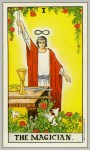
We must keep in mind that it is The Magician that guides The Fool, The Trickster Trump. sas

magician-borderRucker, Rudy. (1982). Infinity and the mind: The science and philosophy of the infinite. New York: McGraw Hill.

Related Posts:

Trump: The Killing Trick
Atlas is Shrugging!
Dark Knight Rising
Trickster Donald Trump
I Ching on Donald Trump
Dark Knight Rising
Air Kiss of Death
The Fool and The Magician
Donald Got His Gun
Bulworth “Lonesome” Trump
Hacking into the Trap
American and Russian Shadow Projections

Posted in Uncategorized | 4 Comments

Trump A Killing Trick

batman-killingWe now have the Trickster Donald Trump mythic-reality show four weeks out from the U.S. Presidential Election. We should be alert to the hint Jung gives us that Trump sees himself as a savior. We already heard Trump stating that “only I can solve U.S. problems, I knows more that U.S. Generals, the yesterday that the RNC does not know how to win, I can teach them” – this is a savior complex, a Messiah complex with “symptoms of someone suffering from delusions of grandeur, often reported in someone suffering from bipolar disorder and schizophrenia” (Wikipedia). Or as someone suggested, someone snorting cocaine.

This is a given, the US electorate has a wounded republican candidate and there is nothing that can be done about him, a trickster leads the Republican Party, some think over a cliff and others into the promise land. Trump just announced his shackles have been removed and the immediate public concern was what can this mean – “how more unshackled could Trump get”, Jimmy Kimble asked. At the end of Dark Knight Rises, the Police  Commissioner asks a police officer if he will continue working for the force and his response “structure has become shackles”; Trump is now unshackling himself from the Republican Party structure – first on his hit-list was Paul Ryan.

However, we need to look deeper! Jung gives us such a lens suggesting that “at the end of the trickster cycle some calamity has happened and been consciously understood.” What is this calamity that has already happened and is understood by Trump, who is now preparing a joke to trick voters into believing he is the only one to lead the US out of the disaster? Jung suggests that this calamity rises from our “recognition and unavoidable integration of the shadow”, which exposes “a tangled web of fate”. Almost sounds like the Manchurian Candidate, Enemy of the State, and Dark Knight Rises movies all rolled into one. Thinking… of a movie title for a Spielberg movie are we? Yes, and it will mirror Batman: The Killing Joke. Maybe this title, Trump: The Killing Trick – well… okay not so original.

You can read about this comic book movie plot at Wikipedia, however, what I found synchronicitic is that this movie’s character analysis mirrors a Clinton vs Trump comic book movie analysis. Here is the killing joke’s psychoanalysis of its two leading characters.

The book explores Moore’s assertion that, psychologically, “Batman and the Joker are mirror images of each other”[8] by delving into the relationship between the two. The story itself shows how the Joker and Batman came to terms with their respective life-altering tragedies, which both eventually lead to their present lives and confrontation. Critic Geoff Klock further explained that “both Batman and the Joker are creations of a random and tragic ‘one bad day.’ Batman spends his life forging meaning from the random tragedy, whereas the Joker reflects the absurdity of “life, and all its random injustice.”[9]
The torments that the Joker puts Commissioner Gordon through are meant to serve as “proof that there is something buried deep within each lunatic, a nugget of insanity, that is simply waiting for the right moment to spring forth.”[10] Unlike the Joker, however, Gordon emerges from his ordeal with his sanity and moral code intact. The story is also famous for changing how the Modern Age of Comics perceived Batman comics by bringing it back to its darker roots.[11] The comic book, however, delves deeper in order to present Batman’s own psychology – that he is, in his own way, just as insane as the Joker, and that he and the Joker perceive the world according to differing points of view, with the Joker’s interpreted through a joke.[12]
The Joker serves as an unreliable narrator. He admits to his own uncertainty, as he has disparate memories of the single event (“Sometimes I remember it one way, sometimes another … If I’m going to have a past, I prefer it to be multiple choice!”), accentuating the comic’s depiction of “a world unraveling toward relentless urban violence and moral nihilism …”[13

So, where does this leave us? We have a title Trump: The Killing Trick, we have a parallel story-line from The Killing Joke, whose characters Donald and Hillary need differing psychoanalytical profiles, then we add a few new characters and begin shooting. We know how Trump Loves A Good Disaster, so can we take some of what he is saying for our script? Probably, but let’s not waste time on this, we need to concentrate on the disaster Jung says comes from “the recognition and unavoidable integration of the shadow that tangles us in a web of our own fate.” Let’s carefully re-read this last sentence…

I think Jung gives us a clue of where to begin “untangling the web of our own fate” in looking “In the history of the collective as in the history of the individual, everything depends on the development of consciousness.” So, our focus is to be on the “history of the collective” and here we need to analyze the Shadow Projection of the US and Russia onto each other. Take for example Regan’s projection that “Russia is the evil empire,” or Bush’s that these countries are a “triad of evil.” Understanding that these as US projection onto the other, is the first step in consciousness rising. Russia has a similar task of unpacking its projection onto the US. How well do we think Obama, Putin, and Trump understand this first analytical step to understanding the Other?

So, a new character in Trump’s impending disaster plot, is Russian President Vladimir Putin and the effort to “undermine the faith in the U.S. election” (Time 10.10.2016). The recent Russian hacking efforts are now playing a strategic role at Trump’s impending disaster plot. Here is where we have to focus our camera lens. What is the “whole deal going on” between Trump and Putin. Donald’s killing trick is here.

Seeing into this requires the challenging task of psychoanalyzing the American and the Russian Collective Shadows – then the real challenge, raising their respective levels of consciousness. At the individual level Jung says “the problem constellated by the shadow is answered on the plane of the Anima, that is, through relatedness”.  The issue confronting us now is that problems constellated byAmerican and Russian Shadow Projections have no collective Anima to bring a higher level of consciousness. The UN seems not to have been able to assist in the growth of consciousness – I doubt they even understand what this might be.  What is left, so it seems, is Trump choreographing his savior roll – a very real disaster in the making as now hear him calling into question the honesty of the US’s election process if he looses. After his defeat, his plan is to lead his 35 million supporters in a up-rising, a violent revolution some are calling for. I think this is an outline of the trick Trump is working on? Need to think more on this – let’s sleep on this and observe for clues in our dreams…

Inception’s hidden meaning of dreams

Maria Konnikova on how to think like Sherlock Holmes

I think Maria Konnikova is giving us an interesting lens to observe and detect Trump’s Killing Trick.

Update November 24, 2019: The US House of Representatives just completed two weeks investigating President Trump’s behavior attempting to enlist the help of a foreign government to meddle in the US’s 2020 elections. I watched much of the Hearings and Fiona Hill was the most impressive. Here is Fiona Hill’s full opening impeachment hearing remarks on November 21, 2019. Youtube has more of her testimony – she is today’s Sherlock.

Sweet Dreams…

Related Posts:
Dark Knight Rising
Trickster Donald Trump
I Ching on Donald Trump
Dark Knight Rising
Air Kiss of Death
The Fool and The Magician
Donald Got His Gun
Bulworth “Lonesome” Trump
Hacking into the Trap
American and Russian Shadow Projections


Posted in Uncategorized | 3 Comments

Atlas Shrugging

I watched the second U.S. Presidential Debate, the talking-heads for an hour after, and then this morning’s Morning Joe Show. As I was watching this morning’s deconstruction of the debate, I became depressed. I then wondered what I would feel like if I stopped watching and listening to all news programs. Let’s try getting up, doing yoga-mediating, getting dreams transcribed, and then continue writing – taking breaks to walk the dogs in the park along the Red River. No news, no discussions, no texting, no Facebook, no nothing to do with any thing going on out in the World – an experiment with time space.

Before last night’s Presidential debate 10.09.16, I watched the “60 Minutes Show” Artificial Intelligence @ http://www.cbsnews.com/news/60-minutes-artificial-intelligence-charlie-rose-robot-sofia/.  and fantasize that these AI efforts will soon allow us to replace politicians with Bicentennial Men and Women.

The logic used by these human politicians, led by a man, not to allow robot Andrew to marry a human is that humans are mortal and would be jealous of anyone with immortality. Years later Andrew again appears before the Senate, now lead by a woman, and he has re-engineered his bio-analytics allowing aging and his death. However, the decision to allow Andrew to marry comes too late as he dies. The logic underlying the movie’s view on immortality is flawed; life could not have evolved without death. It is as important as birth and, besides, we go into it aware. The 60 Minutes AI documentary addresses this fear and Adam Curtis film All ruled over by machines of loving grace looks into challenges confronting us.

I just re-watched “machines of loving grace” and Hillary Clinton appears at the start looking dazed while Ayn Rand is hold-up in New York next to the Empire State Tower. Rand interviewed by Mike Wallace reveals her philosophy – the same as Donald Trump now hold-up in his New York Tower. We get a front row seat to Bill and Hillary Clinton building their Tower. Altas is shrugging!

Part 1 — Love and Power
Part one explores the myth that rose up in the 1990s that computers could create a new kind of stable world: They would bring about a new kind global capitalism purportedly free of risk and failure, without the boom and bust of the past, would abolish centralised political power, and create a new kind of democracy mediated by technology and the Internet, where millions of people would be connected as nodes in cybernetic systems without hierarchy. This film explores how this myth came to be by following two groups that converged on the ideas. One is the small group of disciples around the novelist Ayn Rand in the 1950s who saw themselves as a prototype for a future society where everyone could follow their own selfish desires and that would somehow create a stable and equitable society. The other is the digital entrepreneurs of Silicon Valley, many of whom were also disciples of Ayn Rand, that espoused grand visions of global utopia to be delivered by their technology. They believed that new computer networks would allow the creation of a society where everyone would also follow their own self-interest but that would similarly somehow miraculously bringing a stable and equitable society too. They were joined by Alan Greenspan who had also been a disciple of Ayn Rand, who became convinced that the computers were creating a new kind of “stable capitalism.” BBC

Part 2 — The Use and Abuse of Vegetational Concepts
Part two shows how the modern scientific perspective of the natural world is actually a fantasy. It has little to do with the reality of nature. It is based on mechanistic ideas that were projected on to the natural world in the 1950s by scientists: That nature is a giant cybernetic machine of order that sees humans, and everyone else on the planet, as merely cogs in that machine. In an age disillusioned with modern politics, these ideas began to take on a new appeal, as the “self-regulating ecosystem” model became the basis for the utopian vision of society where technocrats would provide new ways of governing without leaders or politics, along with global visions of connectivity analogous, they claim, to the Gaia theory. These ideas emerged out of the hippie communes in the United States in the 1960s and from counter-culture computer scientists who believed that global webs of computers could liberate the world. But, at the very moment this was happening, the science of ecology discovered that the theory of the self-regulating ecosystem wasn’t true. Instead what was found was that nature is really dynamic and constantly changing in myriad ways. But it was too late, the dream of the self-organizing network had already captured the imagination of the technologists and the wider culture, unwilling to revise technological “progress.” BBC

Part 3 — The Monkey in the Machine and the Machine in the Monkey
This episode looks at why popular culture finds this machine vision so beguiling. The film posits that it is perhaps as all past political dreams of changing the world for the better seem to have failed, the retreat into machine-fantasies that reinforce the desire for it to be true that we have no control over our actions, is an excuse and rationalization of our failure. At the basis of the film is Bill Hamilton, a scientist. He claimed that human behavior is guided by codes buried deep within us—a theory later popularized by Richard Dawkins as the so-called “selfish gene.” Fundamentally, these people claimed that individual human beings are really just machines whose only job is to make sure their ‘genetic codes are passed on for eternity.’ This final part in the series sets out to explain why these theories are problematic, beginning in 2000 in the jungles of the Congo and Rwanda, where Hamilton is to espouse his dark theories. But all around him the Congo is being torn apart. The film then interweaves the two stories: The strange roots of Hamilton’s theories, and the history of the West’s tortured exploitation of the Congo in order to continue manufacturing the technology that keeps the West’s dogmatic utopian ideas alive. BBC

Posted in Uncategorized | 3 Comments

Trickster Trump

raven “Will the real Donald Trump stand up?” This is the challenge now facing the American electorate – deciding who the real Donald Trump is. Some Americans are at a loss identifying the real Trump; however, there is no shortage of labels attached to him. He has been labeled, a deal-maker, successful businessman, family-man, sexist, racist, narcissist, sociopath, psychopath, black-swan, trickster, and other colorful descriptors. Any of these descriptors might be used to gain insight into Trump’s personality but there is one we need to especially consider. Trump the trickster could be sneaking up on us and before we fully comprehend his trickiness, he will be elected the U.S. President. So, the trickster myth archetype will open a window into Trump’s personality and behavior that should help us understand what is unfolding!

Our analysis begins with Carl Jung’s essay On the psychology of the Trickster (1954). When Jung first read Adolf Bandelier’s The delight makers, on the American Indian trickster he was struck by the analogy of the carnivals in the medieval church, where at a certain time of the year there was a reversal of the hierarchic-order and trickster-characters took control of church activities from the bishops. Typical kinds of behavior taking over the church were sly jokes and malicious pranks, the power of being a shape-shifter, the dual nature of being half-animal half-divine, exposure to various kinds of tortures, and the approximation to the figure of a savior. A letter on March 12, 1444, 250 years on, from French bishops still upset about behavior in divine services that had “masqueraders with grotesque faces, disguised as women, lions, and mummers, performed their dances, sang indecent songs in the choir, ate their greasy food from corners of the altar near the priest celebrating mass, got out their games of dice, burned a stinking incense made of old shoe leather, and ran and hopped about all over the church” (137). Kind-of has the look, feel, sound, taste, smell of a Trump rally.

Jung ties this behavior to fairytale characters like Tom Thumb, Stupid Hans, and Hanswurst “who are negative heroes and yet manage to achieve through their stupidity what others fail to accomplish with their best efforts”. Trump shape-shifting as a negative-hero has reversed the hierarchic-order of the Republican Party, through a sly stupidity he defeated all primary contenders and now challenges Hillary Clinton for the Presidency. Trump’s savior complex promise is to Make America Great Again – which he says only he can accomplish – “I know more than all Generals, believe me!” Here then we have a window into what is unfolding.

Jung writes that Yahweh’s Old Testament behavior was that of an “unpredictable trickster with his senseless orgies of destruction and his self-imposed sufferings, together with the same gradual development into a savior and his simultaneous humanization”. Jung suggests that “this transformation of the meaningless into the meaningful reveals the trickster’s compensatory relation to the ‘saint.’” Is the American electorate seeing this and will it take Trump’s word that he understands and will complete this challenging transformation in the weeks remaining? After all, look how long it took Yahweh to transform Himself? In Answer to Job, Jung fully addresses Yahweh’s transformation and “Trump you are no Yahweh!”

The “Phantom of the trickster” can be found in all mythological stories – it is ancient as wile-e-coyoteJoseph Campbell’s study of the Trickster suggests. This antiquity, Jung points out, indicates it is a “reflection of an absolutely undifferentiated human consciousness corresponding to a psyche that has hardly left the animal level.” Campbell suggests that Wile E. Coyote along with the raven and the hair are Indian trickster characters with ancient reality, that address the trickster’s functional meaning. By examining the purpose of the trickster, we have a view of his appearance in the phenomena of Donald Trump. Why is this early primitive consciousness still hanging around like a “senseless appendage” (141)?

Examining the purpose of the trickster myth, we need to go beyond the fact that this myth is more than just an “earlier, rudimentary stage of consciousness”. Like the Winnebago Indian Tribes, uncontaminated by civilization, having lived long with their trickster characters, can we imagine Trump Trickster in an amusing non-treating enjoyment? Jung’s interest is whether these “personified reflections exist in empirical psychology” and he discovered that they do in the form of depth psychology’s early psycho-pathological investigations. These are not random personality splits but exist in “a compensatory relationship with the ego-personality”, which Jung presents as the unconscious in that “the trickster is represented by counter-tendencies in the unconscious, and in certain cases by a sort of second personality, of a puerile and inferior character…,” this Jung calls the Shadow.

Jung explains that “We are no longer aware that in carnival customs and the like there are remnants of a collective shadow figure which proves that the personal shadow is in part descended from a numinous collective figure. This collective figure gradually breaks up under the impact of civilization, leaving traces in folklore which are difficult to recognize. But the main part of him gets personalized and is made an objective of personal responsibility” (142). So, our task now has been re-focused – to examining Trump’s Shadow.

To engage in this inward examination, we need to focus on the trickster-shadow figure from a higher stage of consciousness. If Trump’s consciousness is now moving through the trickster-shadow-stage, we should not expect he will be capable of joining this examination. Jung expects that someone at this lower stage of consciousness will engage life with “a good deal of mockery and contempt and thus casting an even thicker pall over man’s memories of the past,…” An example of this is Trump’s 9.16.2016 news conference, where he finally states that “President Obama wasn’t born in the U.S., period” and in the next breath blames the origin of the “birther issue” on Hillary Clinton – fact-checked as another foggy past memory. Jung points out that “Anyone who belongs to a sphere of culture that seeks the perfect state somewhere in the past must feel very queerly in-deed when confronted by the figure of the trickster.” This “queerly feeling” emanates from Trump’s seeing himself as the savior of America – “being both God, man, and animal at once” – queerly indeed. In such a person, Jung points out; we have “both a subhuman and a superhuman, a bestial and divine being, whose chief and most alarming characteristic is his unconsciousness” (143). Of concern now is what this says about Trump supporters’ level of consciousness.

The desertion bugs_bunnyof many top Republican Party leaders is a clear indication that they see Trump has fallen below their level of consciousness. Jung points out that a Trickster is “so unconscious of himself that his body is not a unity, and his two hands fight each other,… his sex is optional despite its phallic qualities; he can turn himself into a woman and bear children. From his penis, he makes all kinds of useful pants. This is a reference to his nature as a Creator, for the world is made from the body of a god” (144). We need to watch more closely how Trump uses his small hands, however, we already have heard Trump call himself to a Supermodel and learned on Dr. Oz that Trump’s testosterone level is normal. In order for Trump’s body to be a unity, it was reported he changed his height from 6.2” to 6.3” thus at 230 pounds he is not obese.

The trickster in many ways is stupider than the animals as he “does the most atrocious things from sheer unconsciousness and unrelatedness.” The atrocious things Trump is still doing more than a year into this election cycle is in part due to his poor adaption to the political environment that he is immersed in. However, Jung points out that in the trickster myth there is a higher potential for developing consciousness because of “a considerable eagerness to learn”. A struggle now playing itself out is the Trump campaign’s effort is to teach Trump to “stay on script”, which addresses relatedness.  Jung suggests that this effort is fraught with problems because of the trickster’s “extraordinary clumsiness and lack of instinct” and the influence of his savior complex. Can we expect Trump to learn from this trickster myth and is there anything to fear from what he learns?

With the idea of learning now on the table, we need to address its energy. Jeb Bush did appear to have “low energy”, however, our quest is for a dynamically deep understanding of psychic energy. It is important to realize that this ancient primitive trickster myth has not lost its energy and disappeared like expected but has been able to perpetuate itself into an entity with “its own cycle of legends”. This fact testifies to the continuing fascination of the trickster myth and to its reappearance in the Trump phenomenon. Civilization has not been able, if ever it will, put this myth to rest. Jung points to the work of Paul Radin in that “the civilizing process begins within the framework of the trickster cycle itself, … instead of acting in a brutal, savage, stupid, and senseless fashion, the trickster’s behavior toward the end of the cycle becomes quite useful and sensible” (146). What might this sensibility be and can we trust this development?

We experience disgust and fear when Trump goes off-script and there is continuing hope that scripted-Trump will stick around. However, this hope is naïve, since the darkness of Trickster Trump has not gone anywhere but has withdrawn into the unconscious remaining there waiting for an “opportunity to reappear as a projection upon one’s neighbor” or in the case of Trump a tweet about what might happen to Clinton if her bodyguards’ guns were taken away. Jung warns that “If this trick is successful, there is immediately created between them that world of primordial darkness where everything that is characteristic of the trickster can happen – even on the highest plane of civilization. The best examples of these ‘monkey tricks’ …in which everything goes wrong and nothing intelligent happens except by mistake at the last moment, are naturally to be found in politics” (147).  The world is now watching a “primordial darkness” in the American political process unfold.

The trickster myth’s perpetuation, Jung suggests, receives energy not only from sources at higher stages of consciousness but mainly from the personal unconscious, the generator of psychic energy.  To understand this unconscious source of energy, Jung changes our lens of analysis from the trickster myth to what he sees is a parallel process in the psychology of the individual – “the appearance of an impressive shadow figure antagonistically confronting a personal consciousness.” This shadow figure is not an entity still existing but instead “rests on a dynamism whose existence can only be explained in terms of his actual situation …the shadow is so disagreeable to ego-consciousness that it has to be repressed into the unconscious” (145). With the trickster considered to be a “collective shadow figure, a summation of all the inferior traits of character in individuals,” and with the individual shadow always present, the trickster will always have a ready source of energy to tap.

Jung now adds this important point, due to repression and neglect, this energy flow need not materialize as a mythological figure but can surface as a “projection on other social groups and nations” (150). For example, Trump said, “Mexicans crossing the U.S. border are thieves and rapists; the USSR is an evil empire, period”, both which need to be owned as projections about Americans and about America.

Addressing projections is the initial generator of psychic energy in the psychology of the individual.  With the trickster and the individual shadow seen as parallel entities, both trending toward meaning, we have a parallel way to examine the Trump phenomenon. To employ Jung’s lens, depth psychology, the first focus is on the Shadow’s  role in the process of individuation, which is a complex analytical process of the individual Self-moving forward to a meaningful life – the human dream! We need Donald Trump to lay down on our couch.

The Shadow is often unknown or the neglected negative dark-side of one’s personality. These “negative personal inferiorities seen as moral deficiencies” are projected onto an Other. In the case of a man the shadow is male and is projected onto another male. In a woman, the shadow is female and is projected onto another female. It is relatively easy to see (experience) one’s shadow projected onto the same-sex Other. For example, Trump saying that Jeb Bush has low energy is a shadow projection of his. Looking closely at Trump’s energy, we see it is shallow and the worry in Trump’s camp has to be whether his energy-pool is deep enough to withstand Clinton’s deeper energy understanding of the issues.

Preparing for the debates is about expending energy and given the astonishing number of Trump projections, a concern is that they have insulated and are harming him “by acting as a constantly thickening veil of illusion between the [his] ego and the real world.” Trump’s increased lying is a worrying sign! So, the first step in the individuation process is to own shadow projections and in doing so, psychic energy is generated and released for further understanding. (Wikipedia)

Helped by understanding the Shadow, further understanding comes next in tackling one’s Anima/Animus projections.  In our analysis of Trump, his Anima is an archetype in the male’s unconscious that personifies his feminine inner personality, just as the Animus is an archetype in the female’s unconscious personifying her masculinity. These psychic entities like the Shadow are projected outward and in the case of the male unto women and for a woman the projection is unto men. For example, Trump’s many comments about women being “fat, slob, ugly, bleeding, dogs, disgusting animals” opens a very telling-window into his personality – in particular into his relationship with his mother (Mary Anne MacLeod), which not much is known. Mary Pilon’s NewYorker essay on Tump’s immigrant mother only reports that “In his 1997 book, ‘The Art of the Comeback,’ Trump praised his mother—and indirectly criticized other women in his life. ‘Part of the problem I’ve had with women has been in having to compare them to my incredible mother, Mary Trump,’ Trump wrote. ‘My mother is smart as hell.’” Just how smart is hell?

At least Trump reveals this is only part of his problem with women. Coming to understand more fully Trump’s Anima, particularly for a male, is much more difficult than understanding his Shadow. Jung suggests that it is “practically impossible to get a man who is afraid of his own femininity to understand what is meant by the Anima” (151). Trump’s continuing Anima projection onto women suggests he has a deep issue here, which could only be approached if we had the real Donald Trump on a couch – maybe in a new TV reality show. However, many will be watching the debates to see how Trump’s Anima reveals herself – she has very real energy that is going to be a challenge for him to reign in. Of course, his long-term goal should not to rein in Anima energy but to successfully harness it. Given Trump’s level of consciousness, it seems unlikely that he can accomplish this; however, we must keep in mind he is a trickster.

The Shadow is first to appear in individual analysis, which partially hides the Anima/Animus, which in its turn reveals the very powerful wise old man archetype – the sage, king, magician, wizard. We experience this archetype in movies with Obi-wan Kenobi, Gandalf, Dumbledore, and Morphius, so far mostly men with keen wisdomgandalf-the-grey and judgment. They prove most helpful in guiding, saving others. At the end of the trickster myth, Jung suggests “the savior is hinted at. This comforting premonition or hope means that some calamity or other has happened and been consciously understood. Only out of disaster can the longing for a savior arise – in other words, the recognition and unavoidable integration of the shadow creates such a harrowing situation that nobody but a savior [a hero] can undo the tangled web of fate.”                                                                        Gandalf

In the first debate, if Trump is aware of his Shadow, clearly an assets helping him understand how to untangle our National web-of-fate, Jung says that this awareness can only be “answered on the plane of the Anima, that is through relatedness” – a famine trait (151). Understanding the trickster-myth-archetype and watching for the psycho-dynamics in the first male vs. female presidential debate should be interesting. In watching for Shadows, Anima, and Animus projections, keep in mind that a trickster-magician after helping the Hero understand the web-of-fate, disappears from the story leaving the Hero to complete the work – in our story the work of “reversing the hierarchic-order” that is dominating our political system. SAS

Related Trump Blog Posts:
I Ching on Trump
Dark knight rises
Air kiss of death
Coyote and raven tricksters
The fool and the magician
Trump got his gun
Bulworth Lonesome Trump


Posted in Uncategorized | 6 Comments

The Bourne and Obama Legacies

I was multi-tasking yesterday evening watching the movie The Bourne Legacy and the DNC Convention. I like the drone scene where Aaron Cross a member of the Defense Department’s black ops program called Operation Outcome shoots down with his rifle a DOD drown sent to take him out. What is the Bourne Legacy?

When President Obama entered the convention hall my attention turned completely to his address. It captured my imagination and one commentator afterwards pointed out that Obama has delivered captivating speeches at the DNC Convention in 2004, 2008, 2012, and now again – expect this not to be his last was pointed out.

President Obama has lead the U.S. for 8 years and is both loved and hated, which calls us, psychoanalytically inclined, to understand these very intense sentiments that infuse his leadership. I have been interested in Obama’s leadership and will continue examining the change of which Barack Obama speaks and took notice of his saying last night “we need to see ourselves in each other”, which is integral to the change needed. It seems I have been building toward this task for years as these Dialectic Analytical Blog posts indicate. What is The Obama Legacy?

Kapitalism On The Couch
Posted on November 20, 2010

The Yi Jing on President Obama Forward
Posted on November 14, 2012

Barack Hussein Obama – A Transformational Leader?
Posted on February 20, 2013

Transformational Leadership & The Way Of Individuation
Posted on April 16, 2013

American and Russian Shadow Projections
Posted on September 14, 2013

Hacking into the Trap
Posted on March 5, 2015


Posted in Uncategorized | Leave a comment

Integral Spirituality: No Boundaries

I have been watching the DNC convention like I did the RNC’s and despite the interesting news that its computer was hacked in the spring by Putin’s “Trump Super PAC” revealing emails of the DNC plotting to sabotage Bernie’s campaign, the night’s activities have been going smoothly with Sander’s speech unlike Cruz’s rallying his supporters to vote for Clinton. I have been up early listening to MSNBC’s The Morning Joe Show, and its take on the convention so far is upbeat compared with what was seen as the dark-knight-rising experience at the RNC convention.

When the convection coverage ended the other night, I passed by my bookcase and there was Ken Wilber’s book No Boundary looking up at me ‘vibrating’ with its cover of overlapping waves from drops falling into a pool of water. I first read this book in Beijing in 1989 underlining many points and after examining its table of contents turned to re-read Chapter 9, The self in transcendence, wondering why had I not been fully living these principles? It may be that I was not then experiencing Wilber’s ideas such that they left a mark on me in writing about what was then happening. However, only by looking back at my journals can this be confirmed.

The idea of no boundary reminds us of the recent experience of Pope Francis saying we need bridges between Nations not a Trump wall between Mexico and the US. No Boundary is about understanding boundaries first within one’s Self and then between Self and Others, which is about understanding “our selves in transcendence”. What seems to be emerging in our current political climate is that Republicans seem intent on erecting boundaries which Wilber writes goes against the evolutionary unfolding movement to no boundaries. The evolutionary movement of mankind is outward toward greater Globalization, not moving back to Nationalism and trying to re-capture our exported manual jobs from China. The evolutionary-logic of Trump’s party is not on the sound Darwinian ground as pointed out by Wilber.

It has been several years since I last read this book and so I looked up Ken Wilber on Wikipedia and also an update on his Integral theory. I then watched Wilber’s introduction to integral spirituality published on Aug 4, 2015. This clip is long-running an hour 45 minutes but I found it so accurate in laying out a framework to understand our World  NOW – especially interesting is its insight into the reality of terrorism. It even addressed what the emails the DNC got tagged on, whether Bernie was an atheist, indicating a lower level of spiritual thinking by these staffers. Wilber sees the processes of our political life as retarded and offers an interesting developmental framework, centered in part on Carl Jung’s individuation, Abram Maslow’s self-actualization, and Eric Fromm’s to have or to be.

Wilber’s introductory Youtube clip’s description says: “Ken Wilber offers an introduction to a spirituality that honors the truths of modernity and postmodernity—including the revolutions in science and culture—while incorporating the essential insights of the great religions. You will learn how this new evolution in spirituality combines the enlightenment of the East, which excels at cultivating higher states of consciousness, with the enlightenment of the West, which offers developmental and psychodynamic psychology—each contributing key components to a more integral spirituality. On the basis of this integral framework, a radically new role for the world’s religions is proposed. Because these religions have such a tremendous influence on the worldview of the majority of the earth’s population, they are in a privileged position to address some of the biggest conflicts we face. By adopting a more integral view, the great religions can act as facilitators of human development: from magic to mythic to rational to pluralistic to integral—and to a global society that honors and includes all the stations of life along the way.”

Enjoy Wilber’s thought as we finish experiencing the DNC convention and then get ready for the election ‘reality show’ unfolding next? More at http://www.interspirituality.com.

SAScherling

Ken Wilber | Introduction to Integral Spirituality


Posted in Uncategorized | 4 Comments

Anonymous Hackers

Anonymous – The Hacker Wars Full Documentary

Anonymous – Web Warriors Full Documentary

https://www.youtube.com/watch?v=yNdVlkKAjVI
Anonymous – The Story of Aaron Swartz Full Documentary

Anonymous – Chasing Edward Snowden Full Documentary

https://www.youtube.com/watch?v=8YkLS95qDjI


Anonymous – Hillary Clinton: The Hillary Files Full Documentary

https://www.youtube.com/watch?v=b3oTYYTd1F4


Vladimir Putin’s Rise To Power

https://www.youtube.com/watch?v=nY3Uz4ELwM0


Image result for anonymous

How Powerful is Donald Trump

https://www.youtube.com/watch?v=S8B284suwIo
Anonymous The Movie 2015

https://www.youtube.com/watch?v=A42afYZQBQE

Enemy Of The State – The NSA Can Read The Time Off Your F**king Wristwatch!

Enjoy the start of the Democratic Party’s National Convention. If you take a smoke break outside – do not look up!

Posted in Uncategorized | Leave a comment